
Why We Ditched Our Two-Filter Setup for the Blu Technology AR3 — And Why I'm Never Going Back
Tasha Martin • April 16, 2026
If you're still relying on that standard inline filter you grabbed off the shelf, or you're lugging cases of bottled water into your rig every trip, this one's for you.

I have a confession to make: for a long time, I thought we were doing everything right when it came to our RV water. We had the basic inline filter hooked up at the water connection — the kind you grab at any store and think, check, water is filtered. Then, after we figured out that probably wasn't enough, we added a big countertop gravity-fed,
activated-carbon filtration system inside the rig. Two filters. We were covered. Or so I thought.
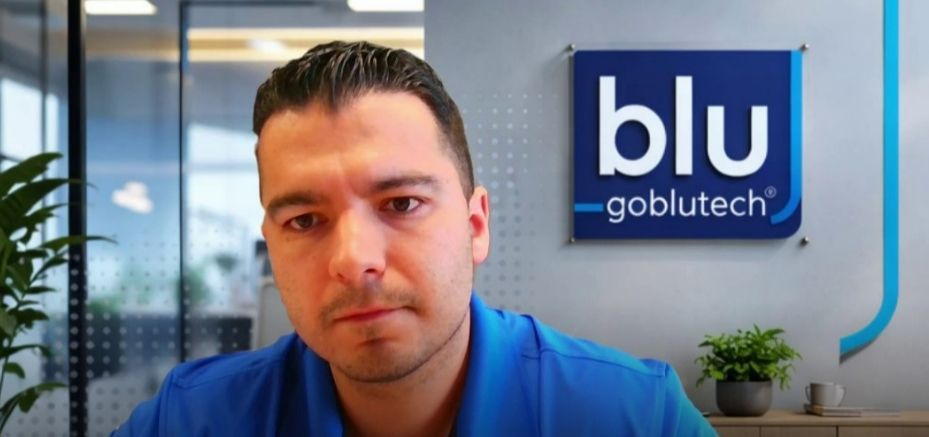
Here's the thing no one really explained when we hit the road as full-timers: campground water is not held to the same standards as the water coming out of your faucet at home. Not even close. And when Rodrigo Barrera, Vice President of Sales at Blu Technology, laid that out for me on a recent episode of Learn To RV: The Podcast
— Beyond the Brand, it finally clicked why our old setup wasn't cutting it, and made me feel a thousand times better about making the switch to the Blu Technology AR3 OFF-GRID 0.2 Micron Three-Stage Water Filtration System.

The Real Problem With Campground Water
I never really thought too hard about where our campground water was coming from or who was checking it. I just figured, it's water, and the campground is open, so it must be fine. But according to Rodrigo, campground water systems are classified as transient non-community water systems, which means the regulations around what gets tested and how often they are tested is far less rigorous than what your municipal water supply goes through at home.
At a municipal level, water treatment facilities test for a wide range of contaminants before it ever reaches your tap.
Campgrounds? The owner of the campground is generally responsible for testing, and the list of things they're required to check is a fraction of what municipal suppliers test for. That leaves a lot of room for things like bacteria, cysts, viruses, heavy metals, hard water minerals, and other contaminants to make their way into your water supply and your RV.
And here's the kicker: you might not even know your water is a problem until it's too late. Hard water, for example, can start damaging your RV's plumbing and appliances relatively quickly if you're camping somewhere with a heavy mineral load and you're not
using a water softener.
Other contaminants, the kind that can actually make you sick,
are completely invisible. You can't smell them, you can't see them, and you definitely won’t taste them. So you have no idea you’ve been exposed to them until there's already a problem.
As someone traveling full-time with my family, I do not love the idea of living on a prayer and a whim, seeing if the water comes out clean.
That is not a risk management strategy I'm willing to accept for our health.

Where We Started: The Inline Filter + Countertop Combo
When we first started RVing, we did what most new RVers do. We grabbed a basic inline water filter from the RV store, screwed it onto our water connection, and called it a day.
It was the obvious first step, it felt responsible, and literally every RV we saw had one. We knew we had to replace it more frequently, but we truly thought it had us covered until we found a more permanent solution.
What we didn't know then — and what Rodrigo explained so clearly on the podcast — is that most of those standard inline filters are 20-micron filters. All they're really doing is catching sediment. Dirt. The big chunks, as I described them during our interview.
That 20-micron filter is not protecting you from bacteria, viruses, or cysts. It's just removing visible debris from the water before it enters your rig.
Once Matt and I started hearing whispers that the inline wasn’t sufficient, we added a large countertop gravity-fed, activated-carbon system inside. And honestly? It helped.
The water tasted better. But it came with its own set of real-world problems. If you've ever traveled with teens, you already know where this is going.
That countertop filter had to be filled manually. Then you had to wait for it to filter. And with two teenagers who never checked the water level after pouring themselves a glass, we were constantly going to get water only to find an empty container. So you'd have to fill it and come back in 20 minutes for your drink.
It was fine. It was just... inconvenient.
Constantly.
And when you're living this life full-time, inconvenient adds up fast.
Especially if you’re thirsty.
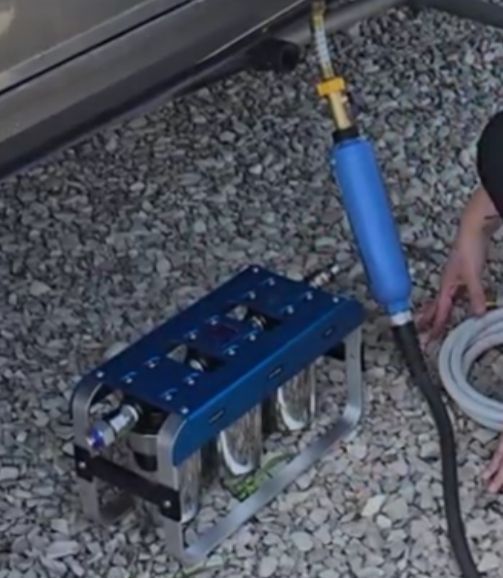
So when I first heard about the Blu Technology AR3 — a fully inline, three-stage filtration system that connects directly to your water supply and filters everything coming into the rig — I was genuinely curious. And when I got my hands on one and had a
chance to talk with Rodrigo about the science behind it, I was sold.

Why the Blu Technology AR3 Is Different
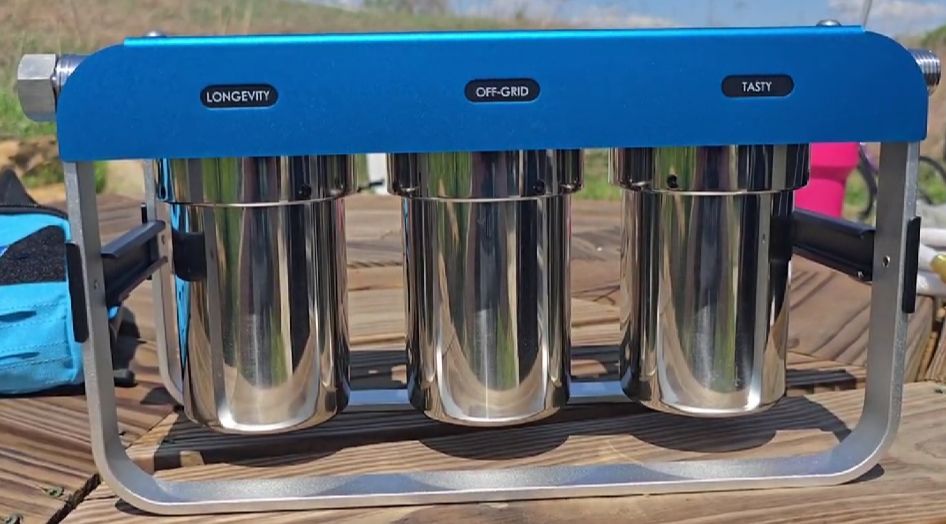
I want to be clear: not all three-stage filtration systems are the same. Rodrigo made that point directly in our conversation, and it's worth repeating here. The AR3 isn't just adding two extra filters to a standard 20-micron setup. The three stages are doing very different jobs, and the heart of the Blu system — the OFF-GRID 0.2 Micron Filter — is
where the real protection happens.
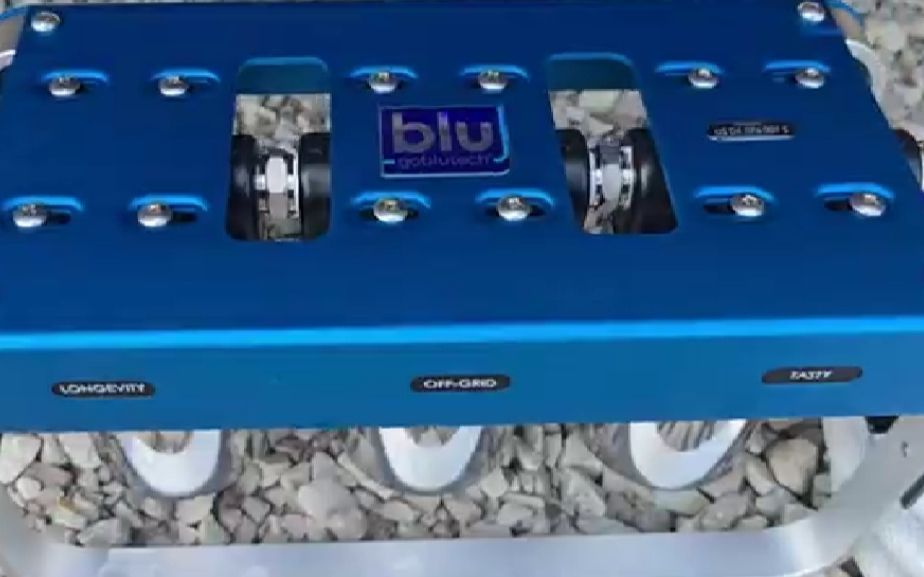
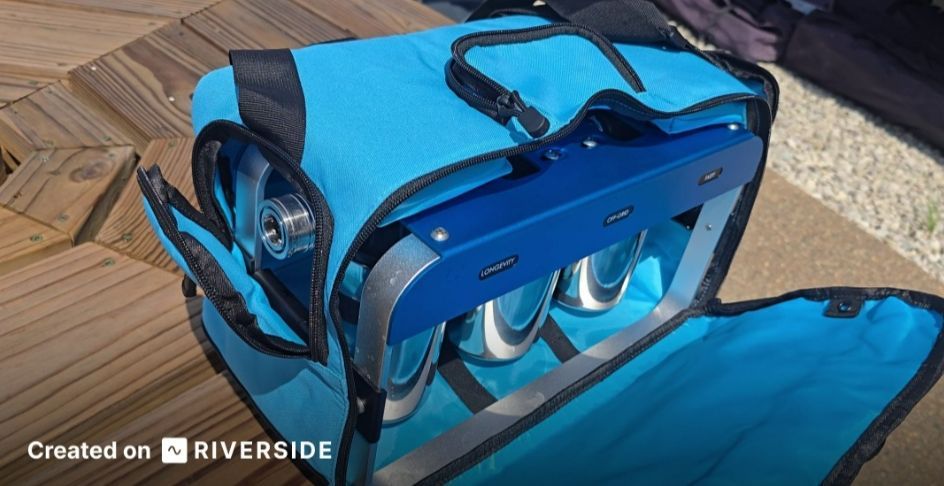
Stage 1: The Longevity Filter
The first stage is a 5-micron sediment filter called the Longevity Filter.
Like the standard inline filter you might already be using, it catches larger debris and sediment. But here, its primary job is actually to protect the filters that come after it and extend their effective
life so the whole system can run for three to four months before you need to swap filters (though, be aware that is an estimated timeline that varies depending on how dirty the water is in the areas you're camping).
Stage 2: The OFF-GRID 0.2 Micron Filter — Where the Magic Happens
This is the filter that completely changed my perspective.
While a standard RV inline filter works at 20 microns, the OFF-GRID filter works at 0.2 microns. To put that in terms that actually mean something: the OFF-GRID filter is filtering particles that are up to 100
times smaller than what a standard inline filter catches. We're talking about particles that are roughly 350 times smaller than a human hair.
At 0.2 microns, this filter is operating at bacteria and virus level. It's certified to NSF/ANSI 42 and 61 standards as a standalone filter. It has also been third-party performance-tested by IAPMO, meaning an independent lab has verified that it does what Blu Technology says it does. And beyond the standard 0.2 micron filtration, the OFF-GRID filter also uses an electro-adsorptive media technology that captures
additional submicron contaminants through ion exchange. That level of protection simply does not exist in a standard inline filter.
One thing I want to address because it came up in our conversation on the podcast: if you run your water through the AR3 and then test it with a TDS (total dissolved solids) meter, you might see a reading that seems high. Don't panic. The AR3 is not a reverse osmosis
system, and it's not stripping beneficial minerals out of your water.
Those minerals — the ones that actually contribute to water’s good taste and your body's good health — pass right through. A TDS tester is measuring electrical conductivity, not the full picture of what is or isn't in your water. The absence of harmful bacteria and viruses doesn't
show up on a TDS meter, but those are the things that matter most.
Stage 3: The Tasty Filter
The third stage is a granular activated charcoal filter made from hypoallergenic coconut husk charcoal. This filter removes odors, tastes, and chlorine that can make your water unpleasant to drink, even after filtration. It's also certified to NSF 42 standards.
Matt’s vote? The water tastes much better now, coming straight right out of the tap. And honestly? He's right. There's a difference.

The Weight Issue Is Real, and the Blu Tech Team Gets It
Here's something that doesn't always come up in water filter conversations but is genuinely important for RVers: weight.
Everything in your rig contributes to your cargo weight.
And when you're a full-timer who has to keep a close eye on your rig's Gross Vehicle Weight Rating (GVWR), every pound matters. You don't want to sacrifice suspension, frame integrity, or road safety because you loaded up on gear like a bulky water filtration system.
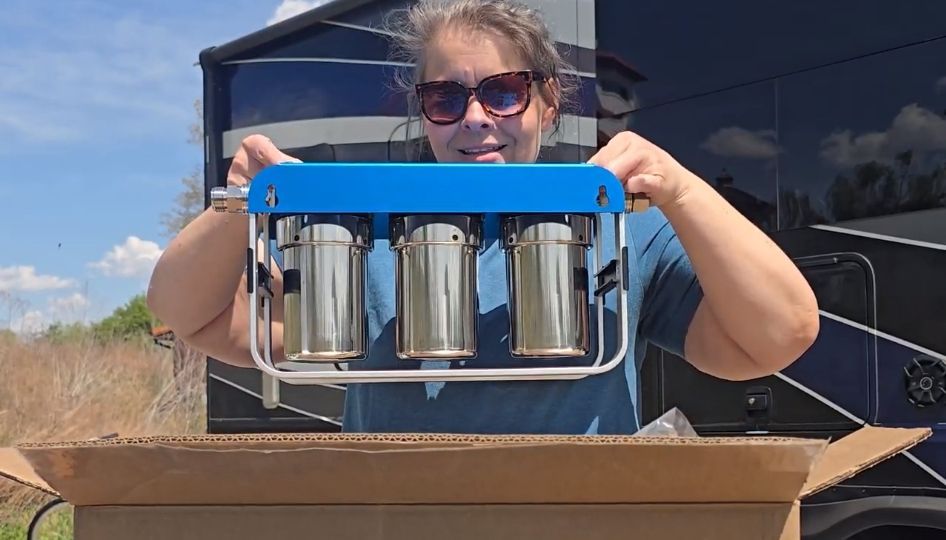
A lot of the three-stage systems I'd seen before the AR3 were built around traditional 10-inch filter canisters. Ten-inch canisters were originally designed for whole-home water filtration, not RVs. Those systems can weigh up to 28 pounds, while the AR3 comes in at just 7.75 pounds. That is a staggering difference, and it's intentional.

Blu Technology engineered the AR3 around smaller 5-inch filters because RVs simply don't use the same volume of water as a residential home.
Five-inch filters are entirely appropriate for the application and allow the system to be dramatically more compact and portable. The frame itself is built from anodized aluminum, which is lightweight and
corrosion-resistant without sacrificing durability. The filter canisters are stainless steel instead of plastic, which I'll get to in a moment.
When we unboxed ours, my first reaction was surprise at how light it was. This is a system that takes weight seriously in a way that matters for people like us.
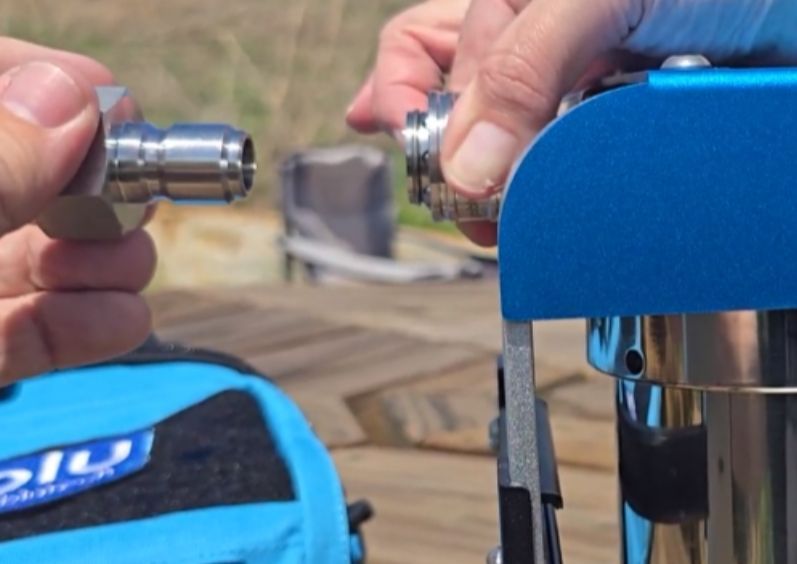
Installation was also remarkably simple, even easier than installing our inline filter. I'd put it on par with breathing, which is exactly how I described it to Rodrigo.

NSF Certification: Why This Matters More Than You Think
I want to spend a little time here because this is the part that sealed my confidence in the AR3, and I think it's undervalued in the RV community's conversations about water filtration.
Many products on the market will tell you they filter bacteria, viruses, and heavy metals.
Some of them probably do. But without third-party testing and certification, you're essentially taking the manufacturer's word for it.
There's no independent verification that the filter performs as described, or that the materials in the system are safe for long-
term contact with your drinking water.
The AR3 is certified to NSF/ANSI 61 standards as a complete system. That means the materials used in the system — hoses, fittings, canisters, all of it — have been tested to confirm they won't leach harmful chemicals into your water, even under conditions like
heat or extended outdoor exposure (both of which are extremely relevant when you're living & traveling in an RV).

The Longevity and Tasty filters are each NSF 42 certified as standalone filters. And the OFF-GRID 0.2 Micron Filter goes even further — it's been third-party performance tested by IAPMO, an independent lab, to verify not just that the materials are safe, but that the filter actually removes what it claims to remove.
Rodrigo said it well: Blu Technology wanted to be able to back up their claims with third-party validation, not just ask customers to trust them.
As a consumer, I deeply appreciate that. It makes me more confident in our choice and more comfortable recommending it to other RV families.
It's also worth noting that Blu Technology is a veteran-owned and operated company, headquartered in Kalamazoo, Michigan, with the AR3 designed and assembled in the USA. That kind of accountability counts.

Less Plastic, More Planet
I already mentioned that we're full-time RVers, which means we're also full-time residents of the outdoors. The condition of the places we camp matters to us personally, which is part of why the environmental angle of the AR3 resonates so much.
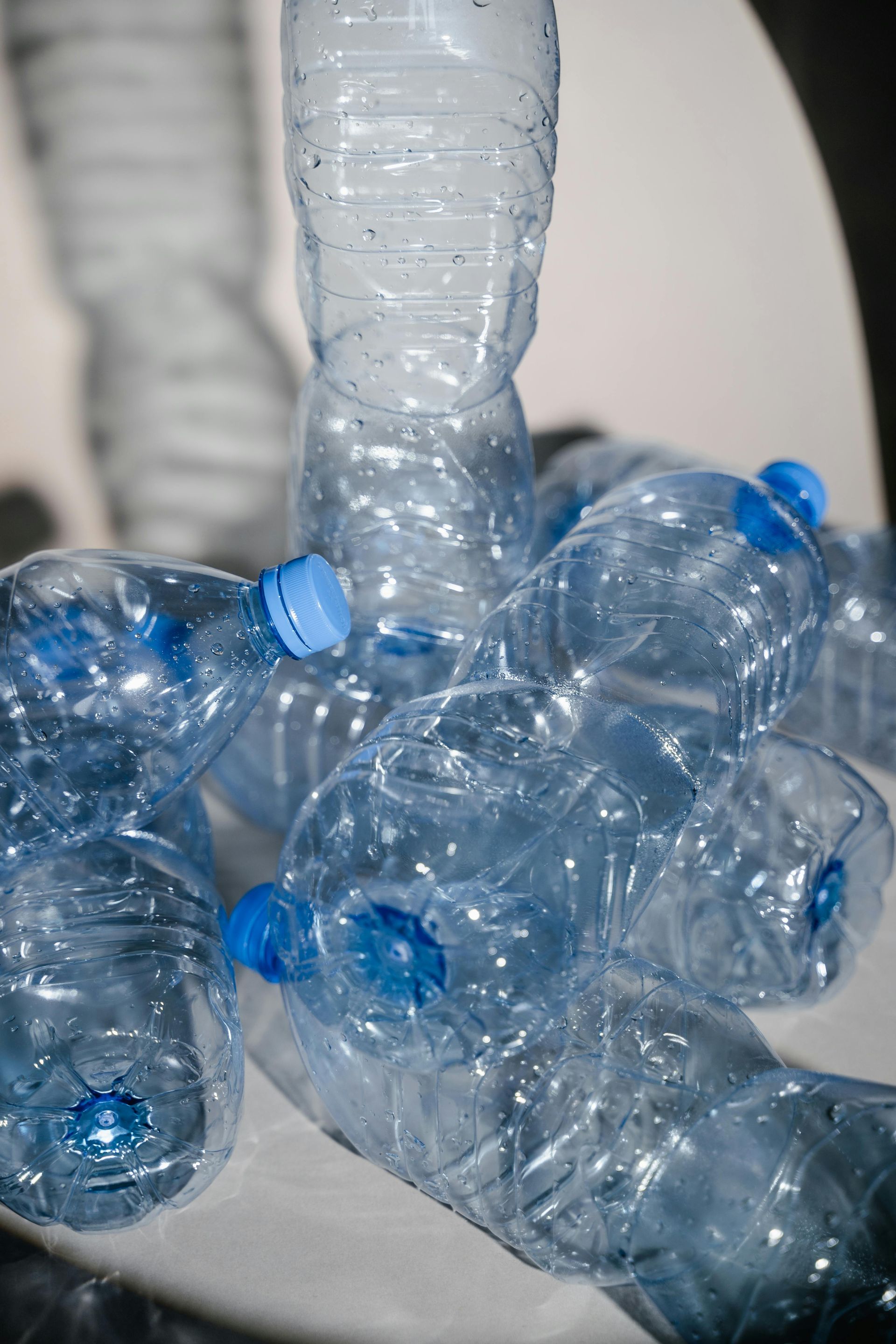
Before we upgraded our filtration, like a lot of RV families, we were supplementing with bottled water. Cases of it. And while I know we weren't alone in this, the truth is that our old setup didn't give us enough confidence to stop buying bottles entirely.
According to Blu Technology's research, a family of four generates about 174 pounds of plastic bottle waste in a single year. That is a genuinely startling number, and it doesn't even account for the transportation weight of hauling all that water into and around your
rig.
On top of that, the AR3's 5-inch filters actually put 50% less waste into landfills than standard 10-inch filters, because less material gets replaced and discarded over time.

Blu Technology also partners with water.org, a nonprofit working to provide access to clean water in underserved communities worldwide.
This is a company that takes its mission beyond the product, and that means something to me.
Now, when we turn on the tap, our water is clearer, smells clean, tastes great, and comes out with good pressure thanks to the AR3's high-flow design. That is a win on every level — for our health, our convenience, our rig's weight capacity, and the planet.
Our Verdict: We're a Blu Tech Family Now
I know that sounds like a big statement, but it's genuinely where we landed.
After comparing what we were using before — the 20-micron inline filter catching sediment and the countertop system that was constantly empty when we needed it — to the AR3, which filters everything inline at 0.2 microns, the difference is not subtle.
Here's what we love most about it:
- It's light. At 7.75 lbs, it's a fraction of the weight of comparable systems and doesn't stress our GVWR.
- It's genuinely protective. The OFF-GRID 0.2 Micron Filter operates at bacteria and virus level — 100x smaller than a standard inline filter.
- It's certified. NSF/ANSI 61 system certification and third-party IAPMO performance testing aren't just marketing claims; they're independent verification.
- It's convenient. Inline filtration means everything coming into the rig is already filtered — drinking water, cooking water, even shower water — without waiting, refilling, or running out.
- It tastes better. Straight from the tap.
- It's better for the planet. No more cases of plastic bottles. Fewer plastic filter canisters heading to the landfill every year.
If you want to hear my full conversation with Rodrigo, including his breakdown of TDS
testing, how to know when to change your filters, tips for storing your filters between
trips, and why the stainless steel and aluminum construction matters, head over to
Learn To RV: The Podcast and listen to Episode 21 of Season 2: Is Your RV Water
Actually Safe? Blu Technology Has Answers.
And if you're ready to check out the AR3 or explore the full Blu Technology lineup, you
can find them at goblutech.com. Keep an eye on their website for the latest product
launches. Rodrigo told me they have quite a few coming in the next couple of years,
and the newest products finishing their NSF certification now will go live on their website
first.
There are a lot of water filtration options out there. But for my family, the AR3 is what we
chose — and after the water conversation I had with Rodrigo, I feel really good about
that choice.
Regardless of where you land, filter your water, friends. As Rodrigo said, you've only got
one body. Take care of it.
Tasha Martin wears a lot of hats — copywriter, Learn to RV the podcast co-host, blogger and passionate community builder.
As an integral part of Learn to RV The Podcast, she shows up every week to make sure no RVer ever has to figure it out alone.
Words are her superpower. People are her purpose.

Other blogs you might like...