




Finding Your Tribe on the Road: Friends & Campfire Chemistry
Jennifer Schillaci • February 26, 2026
The RV Travel Buddy Checklist: Avoid Caravan Drama & Keep the Journey Fun

There’s something about RV life that makes people feel both wildly free and strangely tender. You can wake up with a new view every few days, but you can also feel untethered in a way that hits hard at sunset, when everyone else seems to have “their people” parked three sites over with the string lights and the easy laughter.
The good news is this: the road is full of community.
The tricky part is learning how to find it, nurture it, and sometimes step away from it without setting the bridge on fire.
Whether you’re looking for road friends, a travel buddy, or you’re dating (that's probably another blog entirely!) and wondering if you should roll the dice on traveling together, this is your reminder that you can build a connection out here without losing yourself.
Some of our best seasons on the road have started with us driving away with friends.
Sometimes it turns into months of shared plans and matching routes. Other times it is a few weeks of ebbing and flowing along the same general path, meeting up, splitting off, and circling back when it works.
There is no wrong way to do it.
But traveling with new road friends before you really know them can be both exhilarating and terrifying. Especially when you start learning the details along the way and realize you do not align quite the way you thought you did back when the idea sounded perfect over a few beers.

Why RV Friendships Feel Different (and Sometimes Faster)
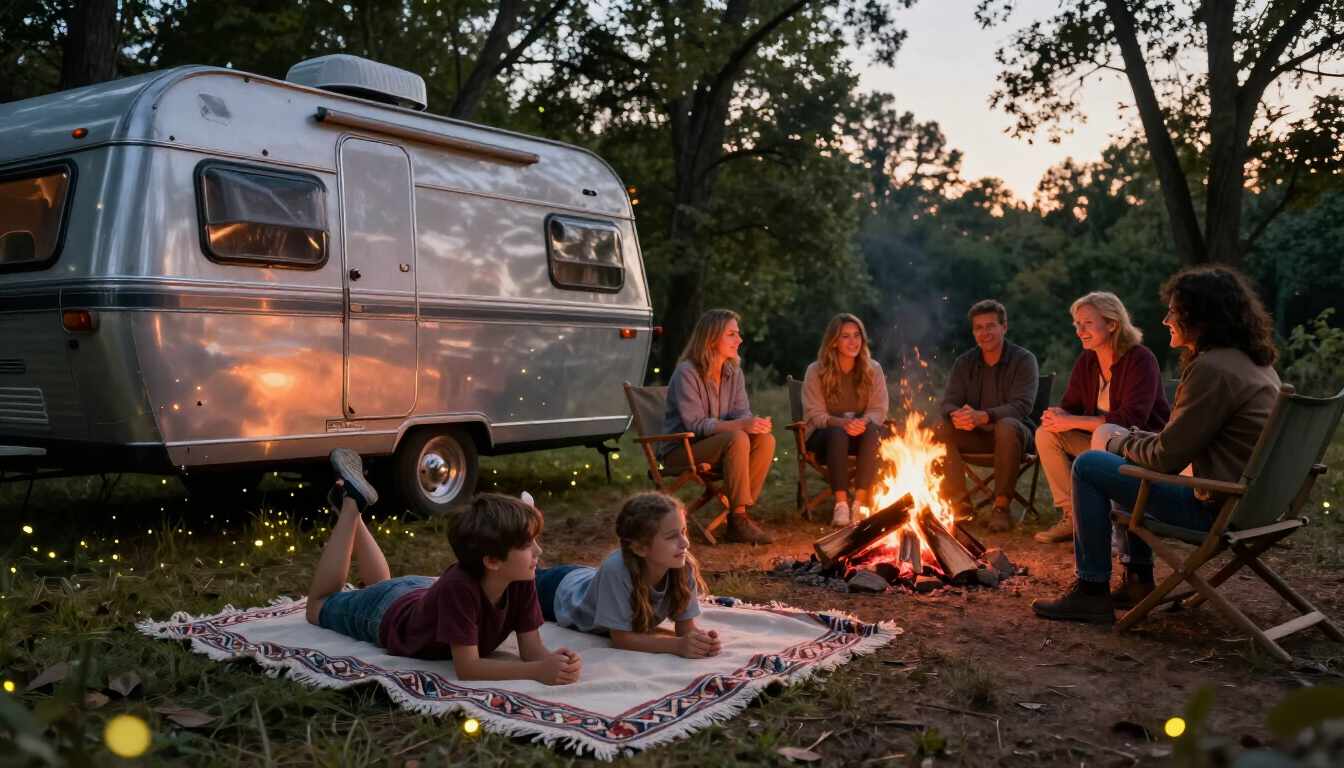
In regular life, friendships can take months to build. You meet someone, you see them occasionally, you make plans, you cancel, you try again. On the road, you might spend three nights parked next to someone and end up sharing more life stories than you have with people back home.
That’s not weird. That’s proximity and simplicity.
RV life strips things down. You’re outside more. People are walking dogs, fixing water hoses, asking if anyone has an extra adapter. Conversations start naturally.
Plus, there’s a shared understanding: you chose this life, and that choice is its own kind of bond. But fast friendship can be confusing. It can feel like finding your tribe after one good campfire talk. Sometimes it is. Sometimes it’s just a beautiful “road chapter” friendship.
Both are real.

How to Actually Make Friends With RV’ers (Without Feeling too Awkward)
You don’t have to be the most outgoing person in the campground to find your people. You just need repeatable, low-pressure ways to connect.
Here are a few that work almost everywhere....
- Be visible. Sit outside. Take a walk. Wave. RV life is “porch life.” If you’re always inside, people assume you want privacy.
- Use micro-openers. Compliment something specific:
- “That’s a great setup.”
- “Your rig is beautiful, what model is it?”
- “How do you like that solar setup?”
- Offer help or ask for advice. RV’ers love sharing what they’ve learned (often the hard way).
- “Have you found a good dump station nearby?”
- “Do you know if the wind gets bad here?”
- Join the temporary community hubs.
- campground events, potlucks, laundry rooms (seriously), dog parks, trailheads, visitor centers
- Say yes once. Not forever. Just once.
- If someone invites you to a walk, a campfire, or coffee, try saying yes one time. You can always return to your own space after.
Most importantly: don’t assume everyone already has their group. A lot of people are quietly hoping someone will talk to them first.
Not every friendly conversation has to turn into friendship, and not every friendship turns into your tribe.
Your tribe is the group where you can exhale. Where you can be your full self without performing. Where your travel style and values don’t constantly clash.
Here are a few “tribe signals” worth paying attention to:
- Similar pace: Are they “drive every day” people or “stay a month” people?
- Similar budget: Do they like free camping, bougie resorts, or a blend?
- Similar energy: Are they constant socializers or do they value quiet?
- Similar lifestyle boundaries: Drinking culture, noise, pets, kids, politics, faith, etc.
- Similar conflict style: When things get weird, do they communicate kindly or get passive and dramatic?
You can like someone and still not travel well with them. That’s not a failure.
Finding Your Tribe

The “Travel Buddy Dating” Mindset (Friends Edition)
Committing to a long route with someone you barely know is like signing a lease together after one coffee. It can be amazing, but it deserves a slower ramp.
Think of it like:
- Match (you meet and vibe)
- Screen (you compare travel styles)
- Trial run (you do a short trip)
- Commit (you book the big route)
- Exit plan (you agree how to split if needed)
The Travel Buddy “Application” (Questions That Save the Trip)
These are the questions that matter before you say “Let’s do the whole Route 66 together.”
Pace + style
- How many drive days per week feels good?
- Do you like early starts or slow mornings?
- Are you a planner or spontaneous?
Money + budget comfort
- What’s your nightly budget range?
- Do you prefer RV parks, state parks, or boondocking?
- Are you okay splitting costs, or do you prefer “everyone pays their own”?
Togetherness expectations
- Are we traveling “together together” (same campground, same days), or more like “same general route, meet up sometimes”?
- How much solo time do you need?
Rules + boundaries
- Quiet hours, guests, drinking, pets, smoking, music volume.
- What’s a hard no for you on the road?
- Are you a night owl & your travel buddies.... are not?
Stress behavior
- What happens when you’re tired, lost, or something breaks?
- Are you direct, avoidant, snappy, problem-solver?
Must-sees vs must-avoids
- What are your “non-negotiable” stops on the journey?
- What kinds of places do you hate?
If someone gets defensive about basic questions, that’s useful information.

The “Date” Phase: Low-Stakes Trials Before a Big Commitment
Before a full iconic route, do these in order:
- One campground weekendSee how communication feels.
- A 3–5 day mini-routeIncludes at least one driving day and one decision day.
- A 2-week stretchLong enough for real habits to show up.
During the trial, there are some things to watch for.
- Do they make decisions with you or at you?
- Do they respect your downtime?
- Do you feel more relaxed or more on edge?
Compatibility is less about being “nice” and more about being easy to travel with.
Define the Commitment (So Nobody Assumes)
A lot of travel-friend breakups happen because one person thought:
“We’re doing this whole thing together.”
…and the other person thought:
“We’re loosely caravanning.”
Before you commit, agree on:
- What “together” means (same sites or just same route)
- How far you’re committing (full route, one state, two weeks)
- Decision rules (how you choose stops, pace, rest days)
- Communication cadence (daily check-in, weekly planning session)

You Can Do This (and Keep the Friendship)
Yes, you can absolutely find your people on the road and pull off a big trip together, like Route 66, without it turning into a weird, tense reality show where someone “accidentally” leaves someone else at a Love’s in Oklahoma.
But here’s the truth that makes it work: friendship is an investment, not just a shared playlist and a mutual love of vintage roadside signs. Investing in a travel friendship looks like asking the un-fun questions early, doing a short “trial run,” and being brave enough to say, “Hey, I need a little alone time today,” before it becomes, “I’m going to ‘run to the store’ and never return.”
The Best Part: A “Breakup Plan” That Protects the Friendship
This is the secret sauce. Normalize it like adults:
- “If one of us wants to change pace, we say it early.”
- “Either person can call for a split with 48 hours notice.”
- “We part with appreciation and no trash talk.”
- “We agree on how shared reservations or costs get handled.”
And honestly, the things that derail a caravan are rarely the “big” things people think to discuss. It’s usually the small stuff you only discover after day five when everyone’s hungry, it’s 97 degrees, and the GPS just rerouted you onto a road that absolutely does not want your rig.
Like:
- The social battery mismatch. One person is a total extrovert who thinks “traveling together” means every meal, every stop, every night around the fire. Another person is an introvert who needs quiet mornings and a little space to recharge. Nobody’s wrong, but if you do not talk about it, somebody ends up feeling rejected and somebody else ends up feeling smothered.
- The snack situation. It sounds ridiculous until it isn’t. Maybe someone is allergic to peanut butter and another person treats peanut butter like an essential RV supply, right up there with sewer hoses and leveling blocks. Or someone is gluten-free. Or someone cooks with strong smells in a tiny shared space. These are easy fixes when they’re discussed early, and unnecessary drama when they’re discovered mid-trip.
This is why I like to think of it as “travel buddy dating”. Not romance. Not commitment-phobia. Just a smart, friendly process of getting to know how people actually travel before you sign up for months of decisions, schedules, and side-by-side living.
The goal is not to interrogate people or “screen them out.” The goal is to set everyone up to win.
On the road, you don’t get the luxury of shallow connections — every shared meal, every late-night troubleshooting session, every “hey, we’re headed that way too” becomes part of a long-term emotional portfolio.
Friends who show up when the roof leaks or the plans fall apart are the ones who make this life feel steady. They’re the people who sit with you in the lonely moments and celebrate the good ones too. With them, belonging isn’t tied to a place, it travels with you from state to state
You’re investing time, trust, flexibility, and a whole lot of shared miles. The better you communicate up front, the more likely you are to end up with the best kind of RV friendship: the kind where you can laugh about the hard parts later, share the good stuff in real time, and still wave excitedly when you cross paths again—whether it’s next week or next year.