



To Wash or Not to Wash: The Great RV Laundry Debate

Jennifer Schillaci • March 18, 2026

This is a subtitle for your new post

If you've spent any time in RV Facebook groups you've seen the question. It shows up like clockwork, usually from someone who just bought their first rig and is staring at a tiny closet wondering if a washing machine could possibly fit in there.


Do I really need a washer and dryer in my RV?

The short answer is: it depends.


The longer answer is our story — and it has taken us years, a bucket, a plunger, a Craigslist washer, a clothesline, a portable dryer, a ventless combo, and a whole lot of laundromat quarters to figure it out.


So buckle up. We are going to walk you through the entire evolution.

Year One Through Three: No Washer. No Dryer. No Problem. (Kind of.)

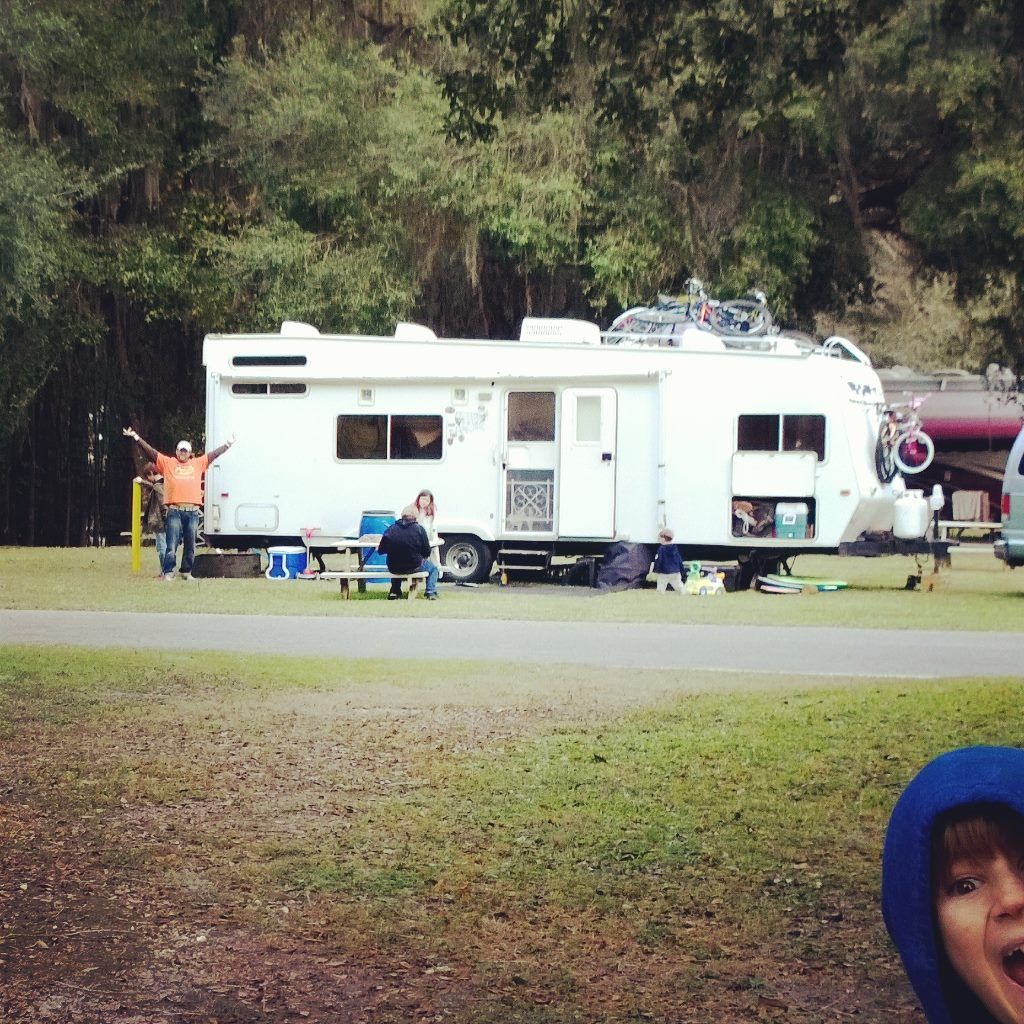
When we went full-time in our first rig, a washing machine wasn't even part of the conversation. There was no space, no budget, and honestly no plan beyond figuring out how to actually live in this thing.


So we did what any resourceful family does. We improvised.


We carried a bucket and a plunger.


Yes. A bucket. And a plunger.


If you've never done laundry by hand you are probably smiling right now. If you have — you already know where this is going.


At first the kids were actually into it. There is something oddly satisfying about agitating clothes in a bucket that appeals to children for approximately two to three weeks. They took turns. They felt helpful. It was almost charming.


And then it wasn't.


The novelty wore off fast. Wringing out jeans by hand is nobody's idea of a good time. And hanging wet clothes in a small RV creates its own set of problems — humidity, smell, and the general feeling that you live inside a laundry bag.


Within a few months we had become expert laundromat hunters. We knew which campgrounds were near affordable ones, which towns had the best machines, and exactly how many quarters it took to dry a full family load. It became part of the rhythm of life on the road — not our favorite part, but manageable.


And honestly? For those first years, the laundromat worked. It got us out of the rig, into town, and sometimes into a coffee shop next door while we waited.

The Craigslist Washer Era: Half a Solution is Better Than None

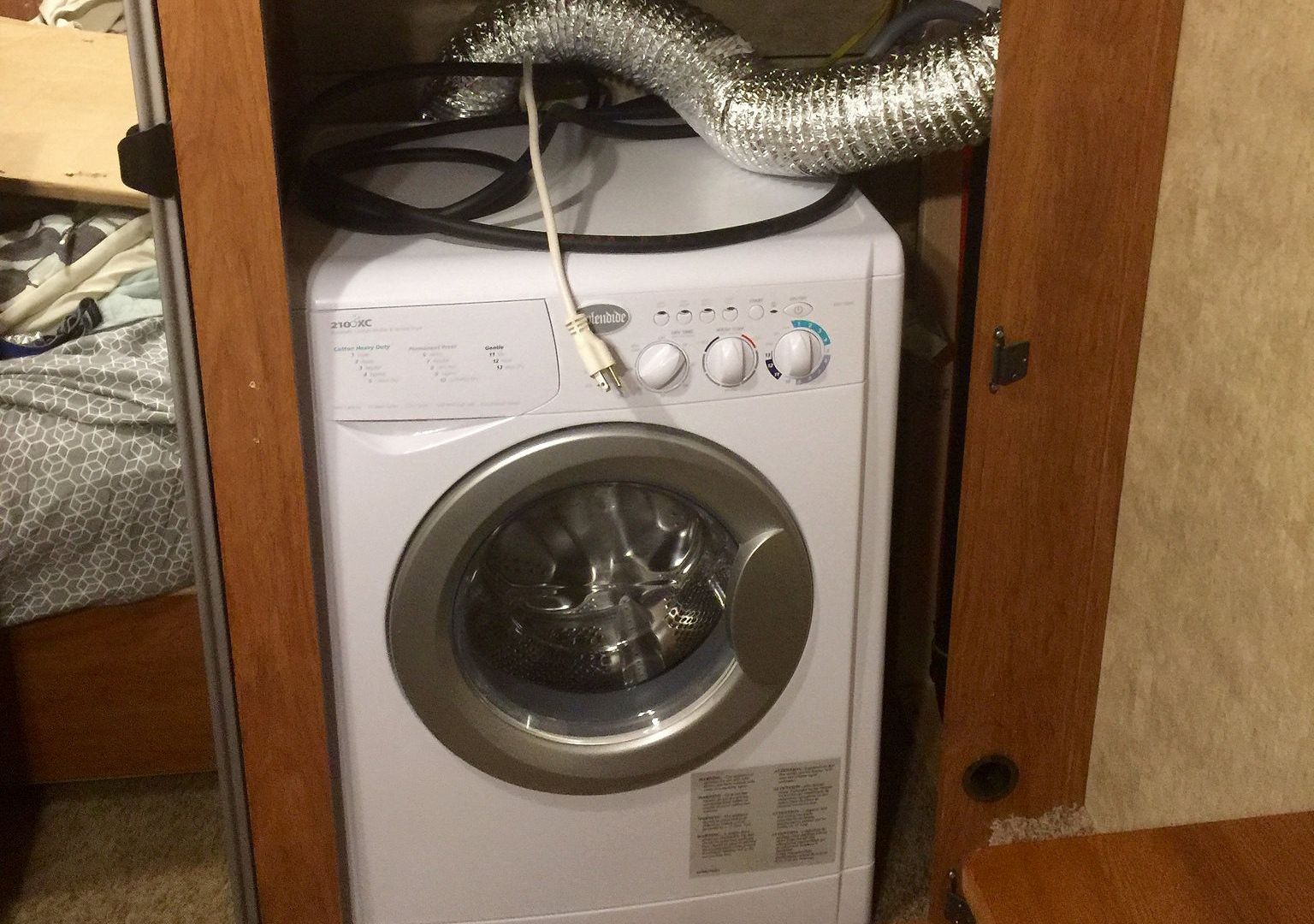
When we upgraded to our fifth wheel in 2016 everything changed. Suddenly there was actual space — a dedicated laundry area that had clearly been designed for exactly this purpose. We weren't going to let that go to waste.


We found a washer on Craigslist.

Just a washer. No dryer.


Now you might be wondering — what exactly do you do with just a washer and no dryer in an RV? Great question.


You get creative.


Frank built a drying rack that could hang off the back ladder of the fifth wheel. On nice days — sunny, breezy, low humidity — it was actually wonderful. Clothes dried in a few hours, smelled amazing, and cost absolutely nothing. There is something genuinely satisfying about line-dried laundry on a beautiful day at a campground.


But then the weather doesn't cooperate. Then it rains for three days. Then you're in the Pacific Northwest in November and your wet jeans have been hanging for 36 hours and they are still wet.


That's when we discovered the most underrated laundry hack of full-time RV life: wash at home, dry at the campground laundromat.


It sounds obvious but it's genuinely brilliant. You do the wash cycle yourself. In our case 1 hour & 39 minures — cheaper, convenient, no waiting for machines — and then you drive wet clothes to the laundromat and throw them in a dryer for 45 minutes. You're in and out in under an hour and you've cut your laundromat costs significantly.


For a while this was our system for a long time. It wasn't perfect but it worked.

The Portable Dryer Chapter: High Hopes, Small Loads

Then one day at a campground someone was selling a stand-up portable dryer.

We looked at each other. We looked at the dryer. We bought it.


It seemed like such a logical solution. A dryer that fits in an RV! No more laundromat trips! No more wet clothes hanging in the rain!


Here is what nobody tells you about portable stand-up dryers: they hold approximately five to six items at a time. Five. To six. Items.


Do the math on a family load. What used to be one washer cycle became four or five separate dryer cycles. What was supposed to save us time was actually consuming our entire afternoon. Laundry went from a manageable chore to an all-day project.


The portable dryer lasted longer than it probably should have before we admitted it wasn't the answer.

The Ventless Combo: A Game Changer With a Catch

In 2020 our friends upgraded their rig and offered to sell us their ventless washer-dryer combo.


There was just one problem. It didn't fit in their rig.


BUT. It fit in ours so we bought it & we sold our Splendide washer to someone else.


And here is where things got interesting, because not all washer-dryer combos are created equal and this is what we have learned that the hard way.


Vented vs. Ventless — What's the Difference and Why Does It Matter?

A vented combo works similarly to a traditional dryer — it pulls air in, heats it, tumbles your clothes, and vents the moist air outside through a hose. It dries faster and more efficiently. But it requires a vent to the outside of your RV — which not every rig has or can accommodate.


A ventless combo uses condensation drying — it heats the air, the moisture condenses on a cool surface inside the machine, and that water drains out. No external vent required. Sounds perfect for an RV, right?


Here's the catch — and here's where science comes in.

Humidity kills the performance of a ventless dryer.


Here's why: a ventless dryer works by creating a temperature difference between the warm moist air from your clothes and a cooler condenser surface. When the air inside your RV is already warm and humid — say, summer in Florida or the Gulf Coast — that temperature difference shrinks. The machine struggles to condense moisture efficiently. Your clothes take longer to dry. You run extra cycles. You wonder if your dryer is broken.

It's not broken. It's physics.


In dry climates or cooler weather a ventless combo performs beautifully. In high humidity environments you will notice the difference and there's not much you can do about it short of running your air conditioning to reduce the ambient humidity in the rig.

Where We Are Today: Our Honest Assessment

We still have our combo unit. We are not willing to give up the space for a stackable washer and dryer — that's a trade-off that doesn't make sense for how we live and how our rig is laid out.


What we love: Doing laundry on our schedule — not the laundromat's. Smaller loads mean clothes get washed more frequently so we're never dealing with a mountain of laundry. The cost savings over time are real and meaningful. And there is something deeply satisfying about throwing in a load at 10pm and waking up to clean clothes.


What we have made peace with: Loads are smaller than a traditional machine. It can be loud. On a bad day it will shake the entire camper — we have learned which campgrounds have the most level sites partly for this reason. In high humidity climates the ventless combo slows down and we adjust our expectations accordingly.


What happens when we get behind: Let's be honest. It happens. A busy travel week, a stretch of bad weather, a busy rally week, a campground where the rig refuses to stop vibrating like a washing machine auditioning for a drum solo — and suddenly the laundry pile has opinions about its situation, and that means the laundrybasket we keep in the shower has taken a shape of its own.


Here is the thing nobody tells you about RV washer dryer combos before you buy one: a full wash and dry cycle can take up to five hours. Yes. Five. Hours. One load. Start to finish.


So when life gets ahead of the laundry, we do not have the luxury of running four loads back to back in an afternoon the way you might in a house. Five hours a load means getting behind has real consequences that require actual strategy.


What we sometimes do We prioritize the essentials first — the things that genuinely cannot wait — and run the machine overnight so the hours work in our favor instead of against us. We start a load before a travel day so it runs while we drive and finishes while we set up camp.


And on the truly dire occasions,  the ones where the laundry has completely won, we surrender & load everything into our giant Ikea bags, find the nearest laundromat, and knock it all out in about 2 hours flat while catching up on a podcast. No shame.


Sometimes the laundromat is the right answer and a five hour cycle is the reason we know that.


What still goes to the laundromat: Bedding. Comforters and heavy blankets are beyond what our combo handles efficiently. We factor one laundromat trip for bedding into our routine and honestly it is not that big a deal. We have simply accepted that bedding day is laundromat day and we plan around it accordingly.


So - Washer or No Washer? Here's Our Honest Answer.

After years of buckets, Craigslist finds, clotheslines, portable dryers, and combo units here is what we actually believe....


A washer on board is worth it if:

  • You have the dedicated space for it
  • You full-time or travel frequently enough that laundromat costs add up
  • You have a family or generate enough laundry to justify it
  • You have allergies to soaps
  • You value the flexibility of doing laundry on your own schedule


The laundromat still makes sense if:

  • You're part-timing or weekend camping
  • Your rig doesn't have a designated laundry space
  • You're washing bedding or oversized items
  • You're in a high-humidity climate running a ventless unit & patience is running thin


The honest truth: For us it was an evolution — not a decision we made once and stuck with. We went from a bucket to a Craigslist washer to a clothesline to a portable dryer to a vented combo to a ventless combo. Every stage taught us something. Every stage made sense for where we were in our journey at that time.


That's kind of how full-time RV life works. You don't have to have it all figured out on day one. You just have to be willing to keep figuring it out.


Quick RV Laundry Guide — What to Know Before You Decide

Types of RV laundry setups:

  • Combo washer-dryer unit (vented) — Best performance, requires external vent, faster drying
  • Combo washer-dryer unit (ventless) — No vent required, affected by humidity, slower in warm climates
  • Separate washer + dryer (stackable) — Best capacity and performance, requires more dedicated space
  • Washer only — Budget-friendly entry point, pair with line drying or laundromat for drying
  • Portable options — Low cost, minimal space, limited capacity
  • Laundromat only — Most flexible, no space or maintenance required, ongoing cost


Pro tips from the road:

  • Wash at home, dry at the laundromat — underrated money saver
  • Always take bedding to the laundromat regardless of your setup
  • Run your AC to improve ventless dryer performance in humid climates
  • Level your rig before running the washer — an unlevel machine is a loud and unhappy machine
  • Smaller more frequent loads are easier on your combo unit than stuffing it full


Have a laundry setup that works for you? Tell us about it in the Learn to RV Facebook communuty. This is exactly the kind of real-world knowledge that makes Learn to RV what it is.


Love this post? Subscribe to Learn to RV The Podcast and follow Jennifer Schillaci and Tasha Martin for more real stories, practical tips, and honest conversations about life on the road.

Other blogs you might like...

By Jennifer Schillaci March 17, 2026
How We Read More Now in the RV Than We Ever Did in a House
Yellow school bus with side mirrors and signal lights against a cloudy sky.
By Ashley Wright March 13, 2026
Can a skoolie survive winter? Ashley Wright of Gypsy Gameschooler shares real tips, lessons, and what full-time skoolie life looks like when temps drop.
Gravel path winding through a lush green forest, sunlight dappling the ground and trees.
By Jennifer Schillaci March 12, 2026
Thousand Trails looks different than it did a few years ago. Learn to RV shares what has changed, what it means for your membership, and how to make the most of it.
By Steve Gallaher March 11, 2026
America's 250th Birthday, One Road Trip at a Time & a Shirt That Gives Back
Boy in green hat and shamrock glasses, raising a hand. White background.
By Jennifer Schillaci March 10, 2026
March is bursting with learning on the road — Women's History Month, César Chávez Day, St. Patrick's Day, cherry blossoms, migration. Your March roadschooling guide.
Turtle on a sandy beach, close to the water's edge.
By Jennifer Schillaci March 5, 2026
What is your RV brand's mascot? Discover the stories behind Tiffin Turtles, Forest River Frogs, Grand Design Bears, Jayco's Blue Jay, Brinkley's mountain logo,& more
Two people stand on a desert road with red rock formations in the distance under a cloudy sky.
By Our Voyage with MS - Kreg & Charlene March 4, 2026
When MS changed everything, Kreg and Charlene didn't stop living. Their story of resilience and full-time RV life with a chronic illness will inspire you.
Pink cherry blossom flowers blooming on a branch.
By Jennifer Schillaci March 3, 2026
Where are the best places to see cherry blossoms by RV this spring? Top destinations, peak bloom dates, and RV and travel tips inside.
Person's ear being examined with an otoscope by a gloved hand.
By Ashley Gallaher : Campfires & Motors March 1, 2026
How does hearing impairment affect life on the road? Ashley Gallaher of Campfires & Motors shares her personal RV living experience with hearing loss.
A large, illuminated dragon sculpture in blue, gold, and orange, surrounded by other lit displays. A pagoda is in the background.
By Jennifer Schillaci February 26, 2026
Looking for the best festivals to attend by RV in 2026? From music and culture to downright weird and wonderful — your ultimate RV festival bucket list is here.
Show More