
The RV Black Tank and Gray Tank Guide Nobody Warned You About
Jennifer Schillaci • June 8, 2026
Nobody gets into RV life because they're excited about the tanks.
You get in for the sunsets, the freedom, the road stretching out ahead of you. The tanks are just... there. Waiting. A necessary reality of life on wheels that most people quietly hope they can figure out as they go.
Here's the problem: figuring it out as you go with RV tanks tends to be smelly, expensive, and occasionally traumatic.
That's why we made this your one-stop guide & why we sat down with Tim and Brenda Bannister of Prime Tank Pros for one of the most unscripted, laugh-out-loud, genuinely useful conversations we've ever had on Learn to RV The Podcast. More on that at the end.
First, let's talk tanks.

What Are the Three RV Tanks and What Do They Actually Do?
Most RVs have three holding tanks, and understanding each one is the foundation of good maintenance.
Freshwater Tank This holds the potable water your RV uses for drinking, cooking, and bathing. It's the tank most people think about the least — until it runs out or starts tasting funny.
Gray Tank This collects all wastewater from your sinks and shower. Food particles, soap, grease, and whatever else goes down those drains ends up here. Gray tanks are sneaky because people assume "it's just soapy water" — and that assumption is where the problems begin. This is often referred to as the galley tank.
Black Tank This is the one everyone nervously avoids talking about. Human waste only. And it demands respect. Ddepending on your RV you may have 2 black tanks.

The One-Two Method: The Simplest Thing You Can Do Right
Tim Bannister of Prime Tank Pros is the kind of person who has seen every tank horror story imaginable & his most repeated piece of advice is also his simplest.
Use water. Intentionally.
Maybe even a bit more than you think you need. Every single time.
Here's the breakdown:
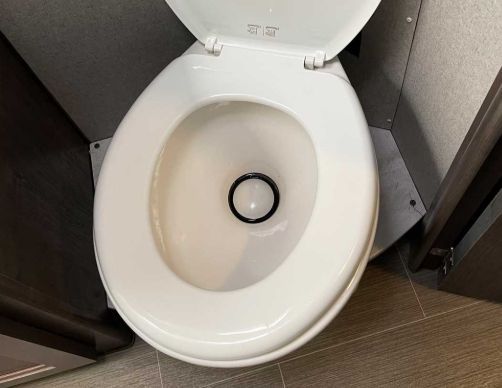
- For liquid waste: Use at least one full bowl of water when flushing.
- For solid waste: Use at least two full bowls of water.
After you dump your tanks, add 5 to 10 gallons of water back in before you move on. That water creates a buffer that keeps waste floating and moving, instead of settling and sticking.
Water is not wasting your resources. Water is protecting your tank & your sanity.

The Dreaded Poop Pyramid (And Why You Never Want to See One)
This is the part of the blog where we say: you've been warned.
When waste sits in a black tank without enough water, it doesn't just sit flat. It piles. It builds. It creates what tank professionals call a pyramid — a solid, calcified mass that no flush system on the market can fully solve without professional intervention.
How do pyramids form? Usually one of three ways...
1. Not enough water during use. Going back to the one-two method — skipping this is the most common cause. Solid waste hits the bottom without enough water to keep it mobile and starts building up.
2. Forgetting to dump.
Full-timers, weekend warriors, and everyone in between has done it. Life gets busy. You forget to dump before a dry camping stretch. The tank sits, the waste settles, and now you have a structural problem instead of a maintenance task.
Prevention is everything here. There is no fun version of pyramid removal.
2. Leaving the black tank "open".
When you leave your black tank valve open on full hookups, gravity drains all the liquid continuously — but solid waste has nothing to carry it out. It sits. It dries. It hardens. And it starts building that pyramid we just talked about.
Your black tank needs liquid to function. The water is what keeps waste mobile and flushable. Without it, you end up with a tank that reads full even after you dump, sensors that stop working accurately, and eventually a clog that no amount of flushing will fix on its own.
The gray tank valve is a different story & many RVers do leave that one open because it's just mostly water. But the black tank valve stays closed, always. Let it fill to about two-thirds, dump it properly with plenty of water, and add water back in before you close it back up.
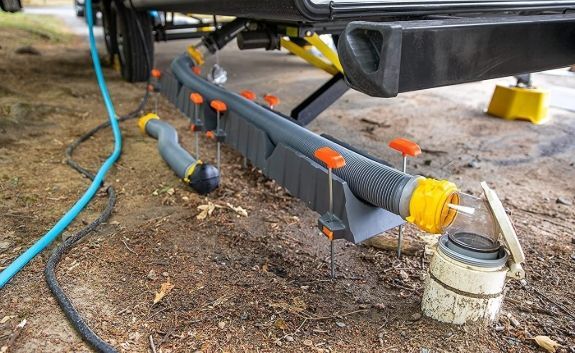
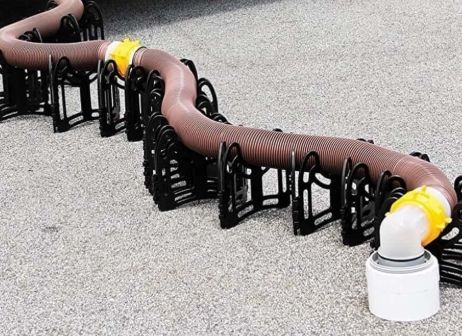
A "poop roller coaster" is the affectionate name RVers give to those sewer hose support systems that create a downhill slope from your rig to the dump connection & it exists for one reason: gravity needs help.
If your sewer connection is at a weird angle, on uneven ground, or your hose has any dips or sags in it, waste and liquid can pool in those low spots instead of draining cleanly. That means stuff sitting in your hose, slow draining, and potential backflow issues.
You probably need one if:
- You're on uneven terrain regularly
- Your dump connection is far from your rig
- You notice slow draining after you open your valve
- Your hose sags anywhere along the run
You could skip it if:
- You're always on level ground with a short hose run
- Your connection point naturally sits lower than your tank outlet
Keep in mind that clean, complete draining every time you dump protects your tank long-term. If a $20-$30 sewer hose support gets everything flowing in one direction the way gravity intended, it's often worth it.

Gray Tank Myths That Are Costing You
The gray tank gets underestimated constantly.
Myth: "It's just soapy water, it basically cleans itself."
False. Food particles from rinsing dishes, grease, hair, and soap scum build up along the walls and in the bends of your plumbing. Left alone, gray tanks develop odors and biofilm that require real attention.
Myth: "If it doesn't smell, it's fine."
By the time your gray tank smells, you're already behind. Regular maintenance keeps you from ever reaching that point.
Myth: "I can pour anything down the sink."
Grease is the gray tank's worst enemy. Even small amounts of cooking grease can coat your tank walls and pipes and create long-term problems.
So... What if the Gray Tank Smells Bad?
It means it's time to sanitize.
That specific smell & yes, it's a real thing, is a sign of bacterial buildup in your gray tank that's past the point of a simple dump and rinse.
When you hit that smell, here's what you can do...
- Dump the tank completely.
- Rinse with your gray tank flush if you have one.
- Run a full tank of water with an RV-safe tank treatment through your sink and shower.
- Let it sit, then dump again.
- Repeat if needed.
And then — start doing this preventatively so you never smell it again.

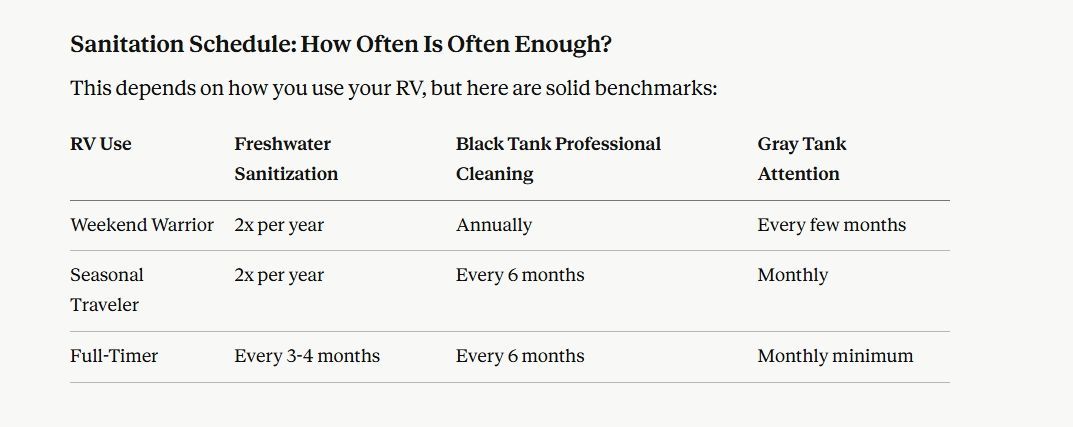
Sanitation Schedule: How Often Is Often Enough?
This depends on how you use your RV, but here are solid benchmarks
Full-timers should treat their tank systems like they treat their tires, with proactive regular maintenance on a schedule, not reactive fixes when something goes wrong.
And if you are not comfortable doing it yourself there are Tank Cleaning companies all over the country just like Prime Tank Pros. In fact, Tim is working on a project to help you easily find one in your area.
Products Worth Knowing About
Not all tank treatments are created equal. Here's what to look for when choosing a tank treatment.
For black tanks: Use enzyme-based or bacterial treatments that actually break down waste, not just mask odors. Formaldehyde-based products are increasingly being banned at campgrounds and harm the biological systems at dump stations.
For gray tanks: A good degreaser treatment helps cut through the buildup that regular water doesn't reach. Some full-timers add a small amount of baking soda down the drain weekly as a baseline.
For freshwater: Bleach-based sanitization is the standard, but follow the dilution ratios carefully. Over-concentrating doesn't make it cleaner, it makes it harder to rinse out and can affect taste long after you think it's gone.

5 Things Every RVer Should Check Right Now
If you haven't thought about your tanks in a while, here's a few things to check.
1. Are your tank valves moving freely?
Stuck or partially open valves are a common cause of buildup and odor. Test them. Replace them before they fail.
2. Do you know your tank capacity?
Knowing when you're at 75% vs. 100% is the difference between a planned dump stop and an emergency. Check your manual if you've never confirmed the numbers.
3. Is your black tank flush system working?
If your rig has one, run it after every dump. If it doesn't — it may be worth adding one.
4. When did you last sanitize your freshwater tank?
If you can't remember, it's probably time. This is your reminder to set a monthly reminder to do this regularly.
6. While you're at it ...take a moment to go up on the roof ....
Why does my RV still smell even when my tanks are fine?
Look up — literally. Your RV's roof has plumbing vent caps that allow sewer gases to escape upward and out of your rig instead of back down through your drains and toilet.
When those caps are broken, damaged, or missing entirely, off-gassing has nowhere to properly escape and can work its way back into your living space.
Most RVers never check them because they're out of sight and out of mind. But a $5-$10 vent cap replacement can sometimes solve an odor problem that people have been fighting for months with tank treatments, deodorizers, and frustration.
Add this to your roof inspection checklist:
- Are all plumbing vent caps present?
- Are any cracked, warped, or broken?
- Are any clogged with debris, wasp nests, or deteriorated material?
6. Have you ever had a professional assessment?
If you're a full-timer who's never had a professional look at your tanks, you may have buildup you don't even know about yet.
Do I really need a sewer hose?
Yes. You do.
We have seen things on the road we cannot unsee.
An RVer pulling up to a dump station, opening that valve, and just... letting it go. Onto the ground. Into the world. For everyone nearby to experience & smell.
No hose. No connection.
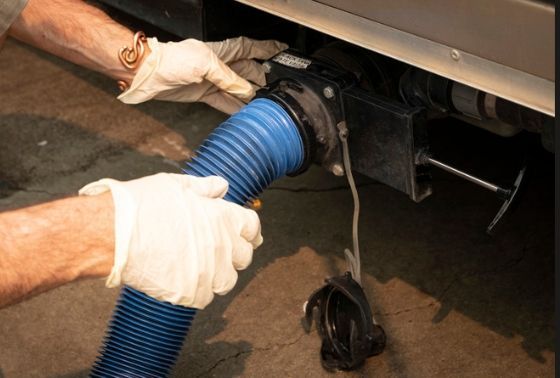
So let's be very clear: a sewer hose is not optional equipment.
It connects your tank outlet to the dump station inlet so that what needs to go underground actually goes underground. Without it you are creating a biohazard, violating campground rules, likely breaking actual laws, and making enemies of every RVer within a quarter mile.
Non-negotiables in your bay before you ever leave home:
- A sewer hose (at least one, ideally a backup)
- Hose fittings and connectors
- Disposable gloves
- A way to rinse your hose after
This is the bare minimum. Respect the dump station. Respect your fellow RVers. And please don't just let it flow.
The Episode That Started This Whole Conversation
Here's the thing about tank talk: it's genuinely hard to make engaging.
Tim Bannister of Prime Tank Pros made it easy. Their episode of Learn to RV The Podcast was completely unscripted — we gave Tim the mic and let him go. Only the format was planned and only the host knew it.
Like everything we do one the podcast, everything else was real, off-the-cuff, and surprisingly hilarious for a conversation about holding tanks.
It was the second most fun episode we've ever recorded. We're still not fully over it. You'll laugh, you might cry ...but the good news this is not a scatch and sniff episode.
If you've been putting off actually learning this stuff because it feels dry (no pun intended) or overwhelming, this is the episode that will change that. Tim helped make it accessible, funny, and actionable in a way that no manual ever could.
🎧 You can always Listen to the Prime Tank Pros episode of Learn to RV The Podcast here It is also available on Apple Podcasts, Spotify, iHeart, Amazon Music, Pandora and YouTube.
Frequently Asked Questions
- How often should I dump my RV black tank?
Dump when your tank reaches two-thirds to three-quarters full. Waiting until it's completely full increases the risk of odor and overflow.
- Can I use household toilet paper in my RV?
Only if it's labeled septic-safe and passes the "jar test" — put a few sheets in a jar of water, shake it, and see if it dissolves quickly. When in doubt, use RV-specific toilet paper.
- What causes RV black tank odors even when I maintain it?
Usually one of three things: not enough water in the tank, a dry
P-trap in a sink or shower, or a failing tank vent. Check all three before assuming the tank itself is the problem.
- Is it okay to leave my gray tank valve open when I'm on full hookups?
Generally, yes — and this is actually one of those myths that causes unnecessary stress for many newer RVers.
Your gray tank collects wastewater from your sinks, shower, and washer if you have one. Most RVers aren't dumping food waste or running a garbage disposal, so significant solid buildup is rarely a concern.
Leaving it open on full hookups means your galley drains freely and continuously, which is generally, perfectly fine.
In fact, leaving it closed when you're not paying attention carries its own risk: a backed-up gray tank can overflow into your rig, and that's a whole different kind of bad day.
The black tank is the one that stays closed. Always.
The gray tank on full hookups? Let it flow.
- How do I know if I have a pyramid in my black tank?
Your tank reads full even after dumping, or flushing doesn't seem to clear readings. A professional assessment from a service like Prime Tank Pros or a local to you RV tank cleaning service professional can confirm and address it.
Want more practical RV knowledge delivered without the fluff? That's exactly what Learn to RV The Podcast is built for.
Subscribe to Learn to RV the Podcast wherever you listen, Follow us on Patreon so you never miss an episode & join other RVers in our FREE Facebook communities.
Other blogs you might like...