Bear Safety in Yellowstone: What Every RVer Needs to Know Before You Hit That Trail
Jennifer Schillaci • May 7, 2026
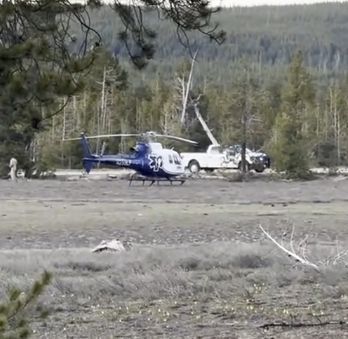
Yesterday, two brothers went hiking on the Mystic Falls Trail near Old Faithful in Yellowstone National Park. They didn't come home that night. They were lifeflighted to Eastern Idaho Regional Medical Center, one brother in serious condition, one in critical condition — after being mauled by a grizzly bear.
Another hiker found one of them by stumbling across a bloody hat on the trail. He heard a voice. "Help me. Help me."
He stayed. He gave the man his shirt. He kept him talking until the helicopter came.
I've been full-timing since 2013. I've spent time in and around Yellowstone country.
And I'm going to be honest with you — this one is different.

In the summer of 2022, some of the kids & I workcamped at the West Yellowstone KOA. It was genuinely one of the best experiences we've had on the road. The original family still owned it at the time, not corporate, and the community there was something special.
West Yellowstone is a gateway town that lives and breathes that park every single day. The people there love it. They respect it. They understand it.
One afternoon I was inside the camp office when a family walked in. Three generations — grandparents, parents, young kids. A beautiful family excited about their Yellowstone visit. They were looking at bear spray on the counter, considering whether to buy it. And then I heard the mother say to her adult daughter:
"Honey, you just spray it on like bug spray onto the kids and it will keep the bears away."
I stepped in.
I say that with all the love in the world — because that mama was doing exactly what a good mama does. She was trying to protect her babies. She just had completely wrong information. And wrong information in bear country can sometimes cause even more harm.
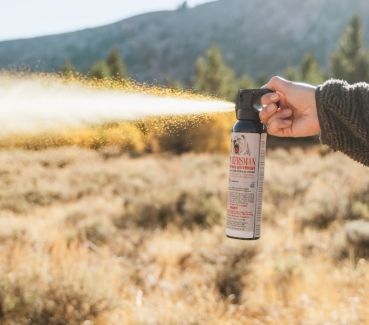
Bear spray is not bug spray. You do not apply it to your skin or clothing. It is a pressurized deterrent that you deploy directly toward an approaching or charging bear — aimed at the bear's face, discharged in a cloud when the bear is within range.
Used correctly, studies have shown it is the most effective way to stop a bear attack.
Used incorrectly, or worse, sprayed on yourself or your children — it is essentially pepper spray on your family's skin. It will burn. And it will do absolutely nothing to stop a bear if you spray it on YOU.
We talked for a few minutes, that family and I. They listened. They bought the bear spray. And I made sure I showed them how to use it before they walked out the door.

That same summer, late one night, a woman came into the store and started loading the counter with every box of animal crackers she could find. I thought she was stocking up for a big group. It was late July so I said, "You must be buying for a whole girl scout troop!" She looked at me and said, completely sincerely "No, I'm going to sort them in the camper and take them to feed to the animals tomorrow."
I stood there for a moment, I am sure my face in disbelief. Then I explained, as gently as I could, that animal crackers are a snack. For people. Not for the wildlife.
Every time I thought I couldn't be surprised by another question in Yellowstone, there was another one. And I say this not to make fun of anyone — but to make a point.
People come to Yellowstone with a lot of enthusiasm and very little information. That gap between enthusiasm and information is where people get hurt. It's where bears get killed.
Because here's the thing about feeding bears — intentionally or not: once a bear encounters human food and associates the opportunity for a meal with humans, it becomes food conditioned. When bears figure out how to access high-calorie human food, they lose their desire to seek natural food sources. A fed bear is almost always eventually a dead bear. And that is on us.
And right now, what I know is that people are still getting this wrong every day in bear country — in very dangerous ways.

Do You Know How Far a Bear Can Smell?
That peanut butter and jelly sandwich in your pack? That cooler in your tow vehicle? That scented lotion on your skin?
Bears' sense of smell is believed to be about 2,100 times better than a human's. For both grizzly and black bears, they can smell food from up to around 20 miles away.
Let that sink in. Twenty miles.
Bears can potentially smell open food, sealed food, canned food, trash, and toiletries across great distances — especially if you've touched the outside of any container with food on your hands. And no, your RV walls are not a barrier.
One report by car enthusiasts noted that bears prefer minivans to other vehicles because the interior is so deeply embedded with the scent of food. If a bear is motivated and downwind, your rig is not a fortress.

And No Pets on the Trails
Yellowstone has a strict no pets on trails policy and it exists for good reason.
Your dog's scent, sounds, and instincts in bear country create a dangerous dynamic for everyone — your pet, you, and the bear. Be mindful of it. Know the rules before you arrive.

We Need to Talk About the Videos
I've been watching footage coming out of Yellowstone today & I have to say something.
People are STILL way too close to the bears.
I'm not talking about just a surprise encounters on a backcountry trail. I'm talking about tourists still creating bear jams, jumping out of their car with a camera in hand to get a closer look, on boardwalks, standing at the edge of meadows with their phones out, inching closer and closer to get the ultimate shot.
What Is a Bear Jam ? And Why It's Part of the Problem...
If you've never been to Yellowstone, you may not know this term. A bear jam is exactly what it sounds like — a traffic backup, sometimes stretching for miles, caused by a bear sighting near a road. Drivers stop. People pour out of vehicles. Phones come out. And suddenly a wild grizzly or black bear is surrounded by a crowd of strangers who have completely forgotten the 100-yard rule because the bear is right there and the shot is right there.
There were 602 grizzly bear jams and 922 black bear jams reported in Yellowstone during the summer of 2025 — an all-time record.
Read that again.
One thousand five hundred and twenty-four bear jams. In 2025 in one summer.
Traffic jams caused by bears in Yellowstone are so common they've earned their own name. When rangers are present they manage the crowd to keep both animals and visitors safe, but the staff is spread thin.
And here is where it gets worse. This is breaking news as of today.
The day after the two brothers were mauled on the Mystic Falls Trail, tourists were yelling at rangers who were warning them to back away from grizzlies and wolves. "They were just walking right up to them," said a Park Service biologist.
The day after. A mauling. And people were still walking up to grizzlies and yelling at the rangers trying to protect them.
I don't have words.
If you encounter a bear jam, stay in your vehicle. Pull into a designated pullout if one is available. Do not exit your car and walk toward the bear. Do not let your children out. Do not get the shot. The bear is not a photo opportunity. It is a wild animal in its own home, and every time a crowd forms around one, we are conditioning it to associate humans with chaos — which is exactly how bears become nuisance bears, which is exactly how bears end up dead. In these situations everyone is often acting like they're at a zoo with a glass wall between them.
If a bear approaches or touches your car, honk your horn and drive away. The park wants to discourage this behavior for the bear's safety as much as yours.
A bear jam is not a party. It is a warning. Slow down, stay inside, and let the animal move on in peace.
The park REQUIRES visitors to stay at least 100 yards away from bears at all times. That is nearly the length of a football field. Not twenty feet. Not "close enough to see its face clearly on my phone screen." One hundred yards.
A grizzly can cover 100 yards in just about three seconds.
A great photo is not worth your life. It is not worth your child's life. If you want a close-up shot of a grizzly bear, get a bigger lens. Hire a wildlife photographer guide who knows how to position safely. Buy a postcard. Create a cartoon in ChatGPT.
Do not get closer.
A reel that goes viral is not worth a life flight to Idaho Falls.
The brothers who were attacked this week were on a trail. They weren't doing anything wrong as far as we know. They were just there, in bear country, in spring, when a mama grizzly with cubs decided they were a threat.
You cannot always prevent a surprise encounter. But you can absolutely stop making choices that put you unnecessarily in harm's way.

What I Know of Three Attacks Since 2021
This isn't abstract for me. I personally know of three attacks in this region since 2021.
In 2021, just a year before we were in West Yellowstone, a 40-year-old West Yellowstone local named Charles Mock was mauled by a grizzly while fishing along the Madison River north of town and ultimately died from his injuries. He got too close to a kill the bear had hidden nearby. A grizzly defending a hidden food source is one of the most dangerous encounters possible & one of the least talked about. If you smell a carcass on the trail or near the water, leave immediately. You don't know what's watching you from the trees.
In 2023, 48-year-old Amie Adamson was found dead on the Buttermilk Trail about eight miles west of West Yellowstone. She hiked that trail regularly, in the early morning hours. A mother grizzly with at least one cub was there that morning too. This KOA is literally 3 miles from where we worked in 2022. That bear likely came through our campground the year before.
And this week — two brothers. On one of the most popular trails in the park near Old Faithful.
These are not freak accidents that happen to reckless people. They are reminders that bear country does not take a day off.

Why Every Bear Lost Matters
Here's something most people don't even stop to consider.... When a bear is killed in an attack, or killed to protect human safety after an attack, that loss echoes through the population for years.
Grizzly bears have one of the slowest reproductive rates among terrestrial mammals. A female doesn't begin reproducing until an average of nearly six years old, gives birth to an average of about two cubs per litter, and the average time between litters is nearly three years. It may take a single female grizzly 10 or more years to simply replace herself in a population.
In Yellowstone National Park, annual cub survival is around 55 percent — meaning that nearly half of all cubs born will not survive to their next winter.
These animals are not bouncing back quickly from our mistakes. Every unnecessary encounter that ends in a bear's death matters. Conservation efforts have brought grizzlies back from just 136 animals in 1975 to over 1,000 today.
That comeback is still fragile.
And it depends on us making better choices.

What You Actually Need to Know
- Bear spray — on your body, not in your pack. And not on your children. Wear it on your hip. Know how to pull the safety clip and deploy it before you ever need to. Practice the motion. I've seen it almost go very wrong in a camp store. Don't let it go wrong on a trail.
- Lock up everything. Everything. Food, coolers, pet food, scented toiletries, cooking utensils. In your rig, in a bear box, hung properly. Bears don't know that your vanilla bean lotion doesn't taste like vanilla bean. A strong smell is an invitation, whether you intend it that way or not.
- Do not feed the wildlife. Ever. Not animal crackers. Not trail mix. Not anything. What feels like a kind gesture creates a food-conditioned bear that will eventually have to be destroyed. It is not kind. It is the opposite of kind.
- Watch the trail before you watch the scenery. Watch for fresh tracks, scat, and feeding sites. See the bear before it sees you.
- Make noise. Hike in groups. Park officials specifically recommend hiking in groups of three or more. Talk loudly. Clap. Use a bear bell. Most attacks are surprise encounters. Give the bear a chance to hear you coming and move on.
- Respect the 100-yard rule. Even for the shot. Get a bigger lens. The bear's life and yours are worth more than the reel.
- No pets on the trails in Yellowstone. Know the rules. Follow them.
- Know which bear and respond accordingly.
- Grizzly attack — play dead, face down, hands laced behind your neck. Do not fight back.
- Black bear attack — fight back with everything you have. Do not play dead.
- Remember: there is safety in numbers. But numbers alone don't make you safe. Safety starts with the choices you make before you ever see a bear.
Bear Bells — Do They Actually Work?
Honest answer: the science is mixed, and you deserve to know that.
A 1982 study in Glacier National Park found that hikers wearing bear bells were less likely to be charged by a grizzly. But a more recent study by U.S. Geological Survey scientist Tom Smith suggests that bears in the wild largely ignore bear bells, treating them the same way they would a bird or background noise.
In the most advanced testing, Smith jingled bear bells in varying volumes in front of brown bears in Katmai National Park. Fifteen different groups of bears ignored the bells completely — but snapped to attention the second he broke a pencil in half.
Smith's conclusion: "From a biological perspective, nothing in their world trains them that tinkling means anything."
What does work?
When Smith walked through thick brush clapping his hands and yelling "Hey bear!" the bears simply moved off ahead of him without being seen or heard. The very simple act of making human noise allows bears time to get out of the way.
So wear a bear bell if it makes you feel better, but don't let it replace your voice. Talk on the trail. Clap. Yell "hey bear" around blind corners. Sound unmistakably human. That is what bears recognize and respond to.
A bell is not a substitute for awareness. Nothing is.

If You Want to See Bears Safely — There's a Place For That
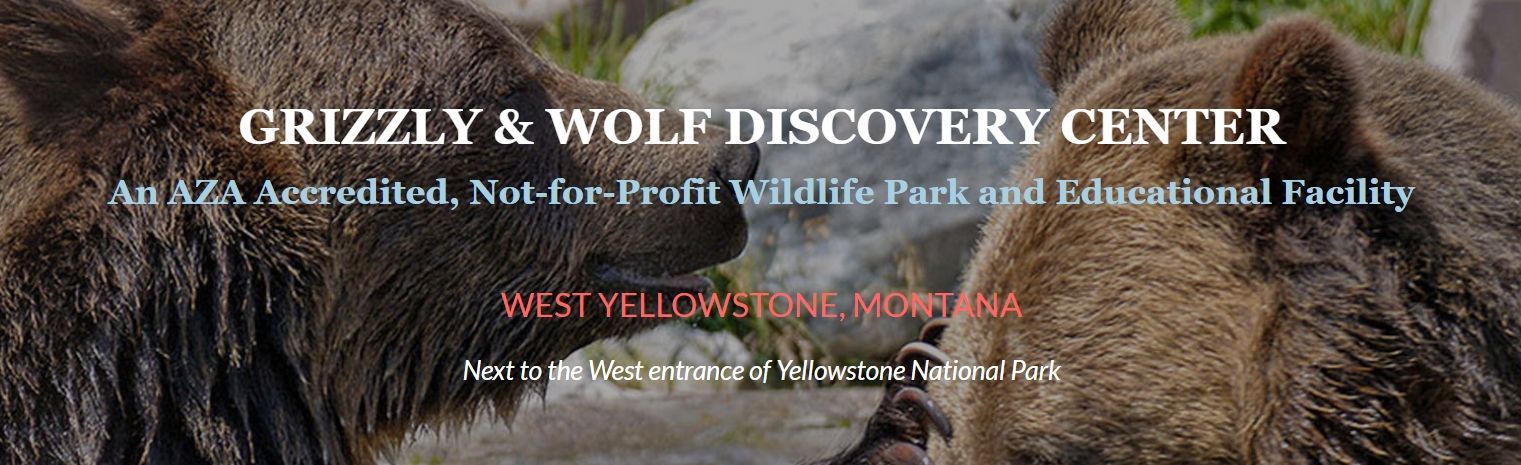
If you're traveling through West Yellowstone and you want to see grizzly bears up close — safely, responsibly, and with real education behind the experience — visit the Grizzly and Wolf Discovery Center in West Yellowstone.
The center opened in 1993 as a sanctuary for bears that were removed from the wild because they had become too familiar or aggressive with people.
Let that sink in.
Every single grizzly at the center had become a nuisance bear, or was the orphaned cub of one, bears that had learned to get food from people, damage property in search of food, or even become aggressive toward people.
Instead of being destroyed, they were rescued and became ambassadors for their species. These bears are lucky to be there. Most bears in their situation don't get a second chance.
The center made agreements with Yellowstone National Park to host educational programs and to test bear-resistant containers for the U.S. Forest Service. The staff is knowledgeable, passionate, and genuinely invested in helping visitors understand these animals — not just observe them. They also offer a Keeper Kids program where children can help hide food in the habitat and watch the bears find it, the way they would in the wild.
The center is open 365 days a year — because unlike their wild counterparts, the bears there do not hibernate.
If you want the close-up experience, go there. That's what it exists for. Get your photo. Learn their stories. Then go into the park and give the wild ones the space they need to stay wild.

The Numbers We Don't Talk About Enough
Before I close, I need to say something I've been sitting with all day.
Those two brothers, I don't know their names. I don't know their family. I do know that somewhere right now, a family is in a hospital waiting room in Idaho Falls praying over two young men who just wanted to see Yellowstone.
A bear attack is no joke. And while this was not a scheduled blog post, I never wanted to write this one, it breaks my heart that it needed to be written at all.
Here's what makes it hit even harder: the park isn't even full yet. In fact, many campgrounds are still days away from actually opening for the season.
Peak summer season hasn't even arrived. The crowds that will pack those trails in June and July and August aren't there yet. This happened in early May.
Bear country doesn't wait for you to be ready.
In 2025, at least 72 grizzly bears died in and around Yellowstone National Park — mostly at the hands of humans. That ties the highest recorded annual grizzly mortality ever documented.
Seventy-two bears.
Now go back and remember what we said about reproduction. A female grizzly doesn't start breeding until nearly age six. She gives birth every two to three years. It can take her ten years just to replace herself in the population. In Yellowstone, nearly half of all cubs born don't survive their first year.
Seventy-two bears in one year is a crisis in slow motion.
Some of those deaths were management removals after human-bear conflicts. Some were vehicle strikes. Some were the direct consequence of human choices — food left out, distances ignored, rules not followed.
Which brings me to something I learned from Yosemite National Park from our summer in Coarsegold, CA, in 2016. When a bear is killed by a vehicle in Yosemite, they place a marker on the road at the exact spot where it happened. You drive past those markers. You see them. You feel them. And you slow down.
Go the speed limit in national parks. Every time. Not because a ranger might be watching. Because animals are crossing those roads that took years to be born, years to be raised, and cannot be replaced quickly. Your schedule is not worth more than their lives.
We lost too many bears last year to human choices that could have gone differently. Let's not repeat it this season.
Bears look magnificent in photos. They are breathtaking to see in the wild.
I never want you to stop experiencing that. I want you to stand at a respectful distance, in a group, with your bear spray on your hip (not in your backpack) & watch a grizzly move through a meadow and feel the kind of awe that reminds you the world is bigger than you.
That experience is available to you & it is totally worth protecting — for you and for them.
Carry bear spray. I hope you never need to use it.
Lock your food. Respect the distance. Hike with people. Make noise. Follow the rules.
And if you ever hear someone in a camp store about to spray bear spray on their kids like bug repellent — step in and please tell them not to.
Other blogs you might like...