Diesel Fill Ups – Truck Stops are a Great Bet

Doug Setzer • April 29, 2025

For the diesel truck owners out there, hitting truck stops on the highway are a great way to get fuel and get on your way with the least amount of fuss and stress of getting around a crowded station. There is a point or two of etiquette that should be remembered (bearing in mind, most everyone around you is “on the job”), but it’s the quickest and easiest in/out with your rig attached.

Etiquette / The Process

Let me first broach the subject of “truckers get mad if you’re there”. Truth is, there may be a bad apple occasionally, but overwhelmingly I have never felt an iota of ill-will from anyone at the truck stops . I’ve had truckers ask me about my truck and how it pulls. I’ve had truckers hold doors and laugh at my kids antics as we make our way through the stores. And I’ve gotten smidges of help when making my way around their parking lots (had a truck tell me to keep going instead of having to get out to check a blind corner as I was parking one day).

When you pull into the truck stop, there may be a “dispatcher” type of person telling folks which lanes to go to on really busy days. Line up like one of the big boys and wait your turn and go where they tell you. Easy-peasy.

If there is no dispatch, shoot for an empty lane because likely you’ll be done and out before the guy beside of you. If there are no empty lanes, you take your best guess at which lane will wrap up the quickest.

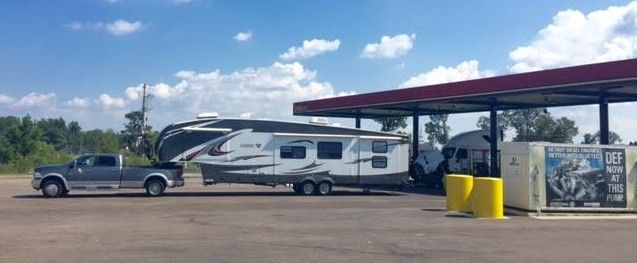
Once you’re done fueling, pull forward so the next trucker can get in behind of you to start filling up while you go in and pay or hit the head. If you’re going to be longer than a few minutes, you should go park your camper in one of the truck spots. Consider it good backing-in practice.

A truck is towing a trailer at a gas station.

Starting The Pump & Credit Cards

This has to be the biggest con against using truck stops  – their pumps are setup for commercial fleet cards. Which means, unless you have a pump authorization card, you have to go inside to have the pump activated. The process is simple- you go inside, give your card and an estimate for how much you’ll need (shoot high, it’s annoying to have to go back in and add more). You go back out and fuel up. Pull forward.  If you want, you can go back in and they’ll immediately refund the difference between your estimate and your actual use. If you don’t go in, they’ll refund the difference sometime later that day (I assume it is when they settle up the register). Since my wife and I almost always travel together, she goes in while I pump. She’ll get snacks or drinks or use the bathroom while I pump and then she’ll settle up the pump when I’m finished.

Get a Pump Authorization Card!  I’m honestly not sure why it took me 2 years of traveling with my diesel truck to finally get a Pilot/Flying J RV Plus card. The best benefit is that you get to start the pumps with it. The other best benefit is that you get a 6 to 9 cent discount on the cash price (where the cash price is usually 5 cents cheaper than the credit price for a total of a 11 to 14 cent discount) .

Start the pump with a Pilot/Flying J card

High Flow Nozzles  – be aware, these fuel pumps and nozzles are designed for the big rigs and are high flow nozzles. For my Ram 3500, I usually start the pump at about 1/2 speed and then slowly let up until it’s running at full speed. I’ve had it spit diesel fuel back at me a time or two when I just open it wide open.

It’s Not All Rainbows And Sparkly Glitter

Nitrile Coated Gloves First, read the “starting the pump & credit cards” section above. If you don’t have a pump authorization card, you have to go inside to authorize the pump, come back out, fuel up, pull forward, go back in and settle up. And, not all companies offer a pump authorization card to RVers. Kudos to Pilot/Flying J.
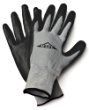
Second, the diesel pump handles themselves are dirty  – like first birthday, eating cake straight fro the cake pan dirty, only not as pleasantly smelling. I keep a pair of nitrile coated gloves under my driver’s seat for diesel fill ups. I didn’t want to the wastefulness of disposables. Before getting them, I used baby wipes to clean my hands but I felt like it didn’t get rid of the smell.

Lastly, the ground is usually stained with spilled fuel. You really have to watch where you step. Some folks on RV forums claim to wear booties (especially those in motorhomes where you’re tracking nastiness into your living area), but I’ve never felt the need to go that far.

Satellite Pumps on the wrong side

I had one instance in western Maryland when I pulled up to the pump where the “computer” portion of the pump was on the wrong side of my truck. I went inside to give my card up and the girl asked if I had ever used a satellite pump before. My confused look was all of the answer that she needed. When I got back outside, it took me a few minutes to realize what she told me:

  1. Take the nozzle off of the pump on the computer/my truck’s passenger side and place it into the garbage can there.
  2. That activated the pump.
  3. Go to the other side of my truck, where my gas tank is and use that fuel pump to fill my truck (you could watch the computer registering the gallons).
  4. Hang both up when I was done.
  5. Pull forward and go inside to settle up.

Other blogs you might like...

By Kirsten McCormick December 11, 2025
Picture this: Ask your teenager what gifts they received last Christmas. Now ask them about their most memorable adventure. Which question sparks more enthusiasm and detailed stories? The truth is, most physical gifts—even those met with initial excitement—often end up collecting dust, breaking, or being outgrown as interests change. But experiences? They become part of who we are, weaving themselves into the fabric of our memories and shaping our character in lasting ways. 
By Jennifer Schillaci December 10, 2025
Surprising Symptoms, Honest Conversations, and Life on Wheels
By Amanda Pelser December 9, 2025
How Homeopathy Supports the Body During Colds and Flus
By Jennifer Aggio December 4, 2025
Let's talk about the thing nobody wants to talk about—but every RVer deals with: RV tank problems . Foul odors. Clogged black tanks. Inaccurate sensors. Slow drainage. The dreaded poop pyramid. Sound familiar? Here's what most RVers don't realize: your onboard tank flush system isn't enough . Those built-in sprayers don't penetrate buildup, remove struvite stones, or scrub away mold and sludge that accumulates over time. That's where professional RV tank cleaning comes in—and that's where Tank Rangers steps up. Tank Rangers is a nationwide RV tank cleaning service with nearly three dozen locations across the country, offering professional hydro-jetting for both black tanks and gray tanks. Whether you're dealing with sensor issues, stubborn odors, or just want preventative maintenance, Tank Rangers provides mess-free, thorough cleaning that gets your tanks back to factory condition. In this guide, we're covering why professional tank cleaning matters, what happens during service, common RV tank myths, DIY maintenance tips, and how to find Tank Rangers near you. Want to hear the full story? We sat down with founder Gabe on our Community Spotlight podcast episode! 
By Jennifer Skinnell December 3, 2025
AT&T Stadium
By Jennifer Schillaci December 2, 2025
Escapee's C.A.R.E. Program, Traveling with a Purpose & Lasagna Love
By Jennifer Schillaci December 1, 2025
From Motorhomes to Movement: How FMCA’s Quiet Shift and FRVA’s Bold Vision Are Reshaping The RV Community
By Jennifer Schillaci November 27, 2025
What RVers Really Want for Christmas
By Jennifer+ Aggio November 21, 2025
Picture this: You're waking up in your RV at a beautiful national park, sipping your morning coffee with a view of the mountains. You spend a few hours greeting campers, answering questions, or doing light maintenance around the campground. The rest of your day? Exploring trails, meeting fellow RVers, and enjoying free camping with full hookups. Oh, and you're getting paid for it.  That's workamping. And if you want to land one of these positions for summer, you need to start applying the fall prior. Here's the reality: the best workamping and camp hosting jobs for are being posted and filled months in advance. National parks, state parks, and popular private campgrounds hire 3-6 months in advance. This guide covers everything you need to know to find and land a workamping position: what it is, when to apply, where to find jobs, how to get hired, and what to ask before accepting. The clock is ticking. Next season’s positions are being filled right now. Let's get you on the road to your best workamping season yet.
By Jennifer Schillaci November 20, 2025
Cultivating a Heart of Thankfulness in a Hard Year
Show More